How to Improve Memory: The Complete Science-Based Guide
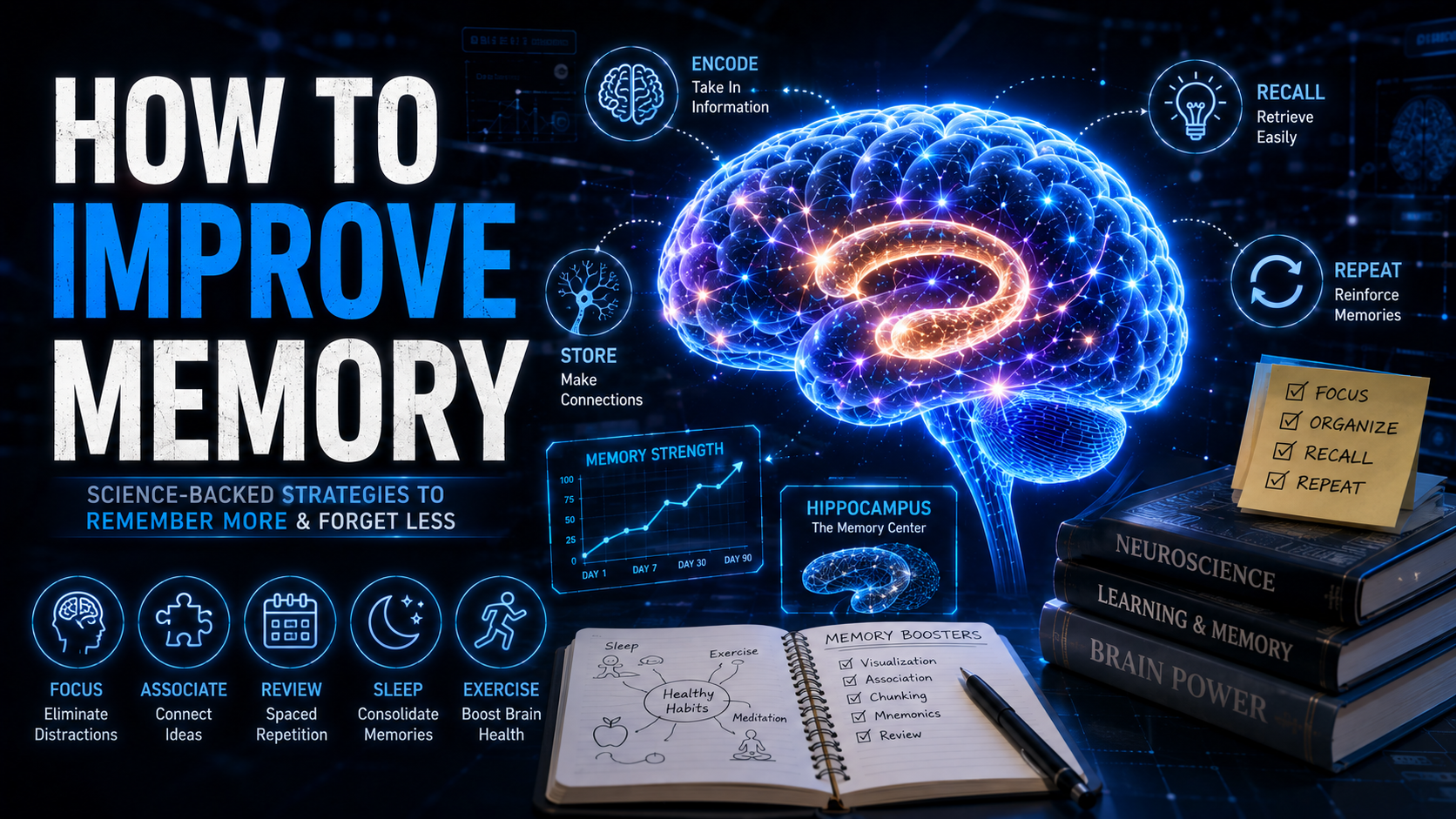
Learn how memory works, why people forget information, and discover proven techniques to improve short-term and long-term memory naturally.
Introduction
Memory is one of the most important abilities of the human brain. Every conversation, skill, experience, and lesson you learn depends on your ability to store and retrieve information. Without memory, learning would be impossible.
Many people believe memory is something you are simply born with. In reality, research shows that memory can be strengthened through healthy habits, proper learning techniques, and continuous mental training.
Whether you are a student preparing for exams, a professional learning new skills, or simply someone who wants to keep your brain healthy as you age, understanding how memory works can dramatically improve your daily life.
What Is Memory?
Memory is the brain's ability to encode, store, and retrieve information. Every time you recognize a face, remember a phone number, or solve a problem using previous knowledge, you are using memory.
Memory is not stored in one single location. Different brain regions work together to process different types of information. This makes memory one of the most complex cognitive functions in neuroscience.
The Three Stages of Memory
Scientists generally describe memory as having three main stages: encoding, storage, and retrieval.
Encoding is the process of transforming information into a format that the brain can understand. Paying close attention during this stage greatly improves later recall.
Storage refers to maintaining information over time. Some memories last only seconds while others remain for decades.
Retrieval is the ability to access stored information whenever it is needed. Strong retrieval pathways make memories easier to recall.
Short-Term vs Long-Term Memory
Short-term memory temporarily holds a small amount of information for several seconds or minutes. For example, remembering a verification code before typing it uses short-term memory.
Long-term memory stores information for days, years, or even an entire lifetime. Childhood memories, language skills, and knowledge learned in school are examples of long-term memory.
Information moves from short-term memory into long-term memory through repetition, understanding, emotional significance, and quality sleep.
Working Memory
Working memory is different from simple short-term memory. It allows you to temporarily hold information while actively using it.
Mental arithmetic, following complex instructions, reading long paragraphs, and solving logic puzzles all depend heavily on working memory.
People with stronger working memory often perform better in learning, reasoning, and problem-solving.
Why Do We Forget?
Forgetting is completely normal. The brain constantly removes unnecessary information to remain efficient.
Information may be forgotten because it was never properly encoded, because similar memories interfere with one another, or because retrieval pathways become weaker over time.
Stress, poor sleep, anxiety, illness, and information overload can all increase forgetting.
The Role of Sleep
Sleep is one of the most important factors in memory formation.
During deep sleep, the brain strengthens newly learned information and transfers important memories into long-term storage.
Students who sleep after studying consistently remember more information than students who stay awake all night.
Adults generally benefit from seven to nine hours of quality sleep each night for optimal cognitive performance.
Exercise and Brain Health
Regular physical exercise increases blood flow to the brain and supports the growth of new neural connections.
Aerobic activities such as walking, cycling, swimming, and running have been associated with better learning ability and memory performance.
Exercise also reduces stress hormones that can negatively affect memory.
Nutrition for Better Memory
The brain requires a steady supply of nutrients to function efficiently.
Omega-3 fatty acids, leafy vegetables, berries, nuts, seeds, eggs, and whole grains all support healthy brain function.
Staying hydrated is equally important because even mild dehydration can reduce concentration and memory performance.
The Power of Repetition
Repeating information strengthens neural pathways inside the brain.
However, repeating everything at once is less effective than spreading review sessions over multiple days.
This technique, known as spaced repetition, is one of the most effective learning strategies ever studied.
Active Recall
Active recall means testing yourself instead of simply rereading information.
Closing your notes and trying to remember concepts from memory forces the brain to strengthen retrieval pathways.
Flashcards, practice questions, and teaching someone else are excellent forms of active recall.
Memory Techniques
Memory champions rarely possess extraordinary brains. Instead, they use powerful techniques that anyone can learn.
Visualization connects information to vivid mental images.
Chunking groups information into smaller meaningful pieces.
The Memory Palace technique links information to familiar locations inside an imagined building.
Mnemonics transform difficult information into memorable phrases or patterns.
How Stress Affects Memory
Short periods of stress can increase alertness, but chronic stress has the opposite effect.
Long-term exposure to stress hormones can interfere with learning and make retrieving memories more difficult.
Managing stress through exercise, relaxation, mindfulness, and healthy routines benefits memory.
Technology and Memory
Modern technology provides instant access to information, but excessive dependence on phones and search engines may reduce the need to actively remember facts.
Constant notifications also interrupt attention, making memory formation less effective.
Reducing digital distractions while studying significantly improves retention.
Brain Training
Activities that challenge the brain help maintain cognitive performance.
IQ tests, logic puzzles, memory games, reaction time exercises, chess, mathematics, language learning, and musical instruments all stimulate different cognitive systems.
The greatest benefits come from learning new and challenging skills rather than repeating easy tasks.
Daily Habits That Improve Memory
Read every day.
Exercise regularly.
Sleep consistently.
Reduce unnecessary screen time.
Eat nutritious foods.
Practice active recall.
Review information using spaced repetition.
Challenge yourself with puzzles and problem-solving exercises.
Stay socially active and continue learning throughout life.
Common Memory Myths
One common myth is that memory naturally declines rapidly with age. While some slowing is normal, many older adults maintain excellent memory through healthy lifestyles.
Another myth is that people only use ten percent of their brain. Modern neuroscience has completely disproven this claim.
Many people also believe multitasking improves productivity. Research consistently shows that multitasking reduces attention and memory performance.
Conclusion
Memory is not fixed. It changes throughout life based on how you use your brain every day.
Quality sleep, regular exercise, healthy nutrition, active recall, spaced repetition, and continuous learning all strengthen memory over time.
Improving memory is not about finding a secret trick. It is the result of consistently building habits that support healthy brain function.
With patience and regular practice, almost anyone can significantly improve learning ability, recall speed, and long-term cognitive performance.
Frequently Asked Questions
What is considered a good IQ score?
An IQ score around 100 is considered average. Scores above average may indicate stronger reasoning abilities, while lower scores simply reflect different cognitive performance compared with the population average.
Can I increase my IQ?
While IQ tends to remain fairly stable, healthy habits, education, regular exercise, quality sleep, and continuous learning can improve cognitive performance and problem-solving ability.
Are online IQ tests accurate?
Most online IQ tests are designed for entertainment and practice. Only professionally administered IQ assessments can provide standardized results.
Does IQ determine success?
No. Success depends on many factors including discipline, education, experience, emotional intelligence, communication skills, and persistence.
Related Articles
What Is IQ? Complete Beginner's Guide
Learn what IQ means, how IQ tests work, average IQ scores, and common myths.
What Is Brain Rot? Causes, Symptoms, and Recovery Guide
Discover what brain rot really means, why it happens, how social media affects attention, and practical ways to improve your focus.
Ready to Challenge Yourself?
Take our free IQ test and discover your cognitive strengths.
Start IQ Test